
Why Governed Information Is the Foundation for Quality, Profitability, and Operational Performance
If you are responsible for manufacturing margin, you are responsible for Cost of Quality.
Cost of Quality is often viewed as a quality metric, but it is fundamentally a business performance metric. It reflects how effectively information moves across engineering, manufacturing, quality, and compliance processes.
When product information flows accurately from design through execution, organizations reduce defects, improve productivity, and protect margins. When information becomes fragmented, manufacturers experience scrap, rework, delays, warranty claims, and rising operational costs.
Many manufacturers focus on improving quality through equipment upgrades, process improvements, and workforce training. While those initiatives matter, one of the most overlooked drivers of Cost of Quality is information management.
Key Takeaways
- Cost of Quality is often driven by information failures, not just production failures.
- Disconnected engineering, quality, and manufacturing systems increase scrap, rework, warranty exposure, and operational risk.
- Enterprise Information Management creates a governed information foundation that supports a digital thread across the product lifecycle.
- Manufacturers that improve information governance can reduce Cost of Quality, strengthen traceability, and improve profitability.
- The most successful organizations treat information as a strategic manufacturing asset rather than an administrative byproduct.
Enterprise Information Management Industry Applications
This article is part of Alitek’s growing collection of industry-specific Enterprise Information Management resources.
Featured Industry Applications
▶ Manufacturing: How Enterprise Information Management Reduces Cost of Quality
Insurance: How Disconnected Content Slows Insurance Modernization
What Is Cost of Quality?
Cost of Quality (CoQ) measures the total cost associated with preventing, detecting, and correcting defects throughout the manufacturing lifecycle.
The American Society for Quality defines Cost of Quality across four categories:
Category |
Description |
|
Prevention |
Activities that prevent defects before they occur |
|
Appraisal |
Inspection and verification activities |
|
Internal Failure |
Scrap, rework, and defects identified before shipment |
|
External Failure |
Warranty claims, recalls, field failures, and customer-impacting quality issues |
For many manufacturers, Cost of Quality represents between 5% and 20% of revenue. In engineer-to-order and build-to-order environments, the impact can be even higher.
The challenge is that many quality costs originate long before production begins.
What Does Enterprise Information Management Have to Do With Cost of Quality?
Manufacturers often treat Cost of Quality as a production issue.
In reality, many quality failures begin as information failures.
Outdated revisions, disconnected systems, uncontrolled documents, manual data transfers, and inconsistent governance introduce errors that eventually appear as scrap, rework, inspection overhead, warranty claims, and compliance risk.
Modern manufacturers operate across multiple systems:
- PDM manages engineering work in progress
- PLM manages released product structures and change control
- ERP manages procurement and production planning
- MES manages manufacturing execution
- ECM manages governed documents, records, and collaboration
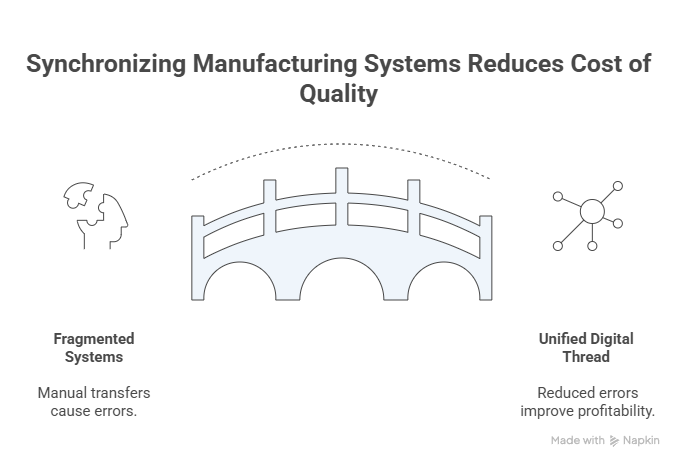
When these systems operate independently, information becomes fragmented and engineering intent breaks down between design and execution.
Enterprise Information Management helps manufacturers govern, synchronize, and control information across these environments, creating a trusted foundation for operational excellence.
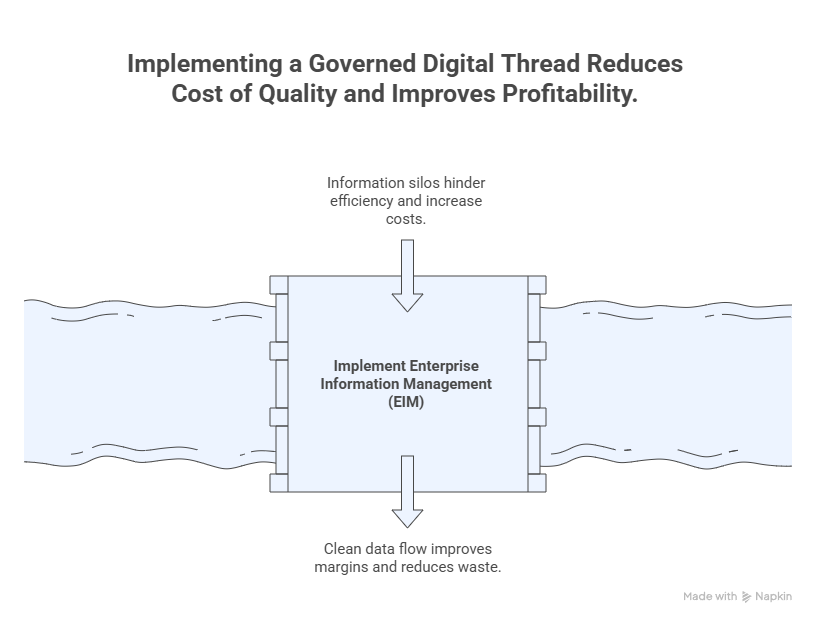
Many manufacturers have invested heavily in technology but continue to struggle with information fragmentation.
Critical product and process information often exists across multiple repositories, applications, shared drives, email systems, and departmental databases.
The result is a hidden information tax that affects nearly every aspect of manufacturing performance.
Information Challenge |
Business Impact |
|
Disconnected engineering and manufacturing systems |
Increased risk of wrong-revision builds |
|
Manual information transfer between platforms |
Data quality issues and process delays |
|
Multiple sources of product information |
Reduced confidence in operational decisions |
|
Inconsistent document control |
Increased compliance and audit risk |
|
Limited visibility into change history |
Slower issue resolution and root-cause analysis |
For a $100 million manufacturer, even a modest quality-related drag on performance can translate into millions of dollars in avoidable cost each year.
How EIM Reduces Cost of Quality
Enterprise Information Management helps manufacturers establish a governed digital thread that connects engineering intent with operational execution.
Rather than focusing on individual systems, EIM focuses on ensuring information remains trusted, governed, and synchronized throughout the product lifecycle.
Cost of Quality Category |
Information Challenge |
How EIM Helps |
Business Impact |
|
Prevention |
Uncontrolled specifications and engineering changes |
Governs revisions, approvals, and change management processes |
Fewer defects introduced into production |
|
Internal Failure |
Obsolete documentation and inconsistent information access |
Creates a single source of truth across systems |
Reduced scrap and rework |
|
Appraisal |
Excessive inspection driven by low trust in information |
Improves traceability and information confidence |
Lower inspection costs and faster audits |
|
External Failure |
Limited product history and weak traceability |
Maintains governed records throughout the product lifecycle |
Reduced warranty exposure and recall risk |
The Digital Thread Is Enterprise Information Management in Action
The digital thread is often discussed as a technology initiative.
In reality, it is one of the most visible examples of Enterprise Information Management in practice.
A digital thread connects information across engineering, manufacturing, quality, compliance, and service functions, ensuring every stakeholder operates from trusted and governed information.
When product information remains synchronized across PDM, PLM, ERP, ECM, MES, and quality systems:
- Engineering changes move faster
- Quality issues are identified earlier
- Traceability improves
- Compliance becomes easier to manage
- Operational risk declines
The digital thread is not the objective. Better business outcomes are.
Enterprise Information Management provides the governance framework that makes those outcomes possible.
Metrics That Matter
Manufacturers often measure the success of EIM initiatives through operational and quality metrics such as:
✅ Engineering Change Order cycle time
✅ First-pass yield
✅ Scrap rate
✅ Rework hours
✅ Inspection cycle time
✅ Audit preparation effort
✅ Warranty claim rates
✅ Root-cause analysis cycle time
✅ Gross margin improvement
These metrics help organizations quantify the business value of improving information quality, governance, and accessibility.
From Reactive Quality to Built-In Quality
In reactive environments, teams spend time correcting mistakes, reconciling conflicting information, conducting additional inspections, and responding to quality issues after they occur.
Built-in quality is different.
When information is governed, synchronized, and accessible, quality becomes part of the process rather than an after-the-fact correction effort.
For manufacturing leaders, Enterprise Information Management is not an IT initiative.
It is a business strategy that improves quality, protects margin, strengthens compliance, and supports operational performance.
Continue Your EIM Journey
Reducing Cost of Quality is one example of how Enterprise Information Management creates measurable business value.
To learn more about the principles behind effective information management, explore the rest of Alitek’s Enterprise Information Management series.
Why Enterprise Information Management Matters
Learn why information has become one of the most important strategic assets in modern organizations and how EIM supports governance, digital transformation, and AI readiness.
The Business Value of Enterprise Information Management
Discover how organizations use EIM to reduce risk, improve operational performance, strengthen compliance, and create a foundation for AI-enabled growth.
How to Define an Enterprise Information Management Strategy
Explore a practical framework for aligning stakeholders, establishing governance, and building a roadmap that turns information into a business advantage.
Together, these articles provide a comprehensive foundation for understanding how Enterprise Information Management drives measurable business outcomes across industries.
Frequently Asked Questions About Cost of Quality and EIM
What is Cost of Quality in manufacturing?
Cost of Quality measures the cost associated with preventing, detecting, and correcting defects throughout the manufacturing lifecycle, including prevention, appraisal, internal failure, and external failure costs.
How does Enterprise Information Management reduce Cost of Quality?
Enterprise Information Management improves information governance, synchronization, traceability, and accessibility, helping manufacturers reduce scrap, rework, inspection overhead, warranty claims, and compliance risk.
What is a digital thread?
A digital thread is a connected flow of information that links engineering, manufacturing, quality, and service processes throughout the product lifecycle.
How do PDM, PLM, ERP, and ECM support manufacturing quality?
These systems manage engineering data, product structures, operational planning, manufacturing execution, and governed content. When synchronized, they help ensure information remains accurate and accessible throughout production.
What metrics should manufacturers track when measuring Cost of Quality?
Common metrics include scrap rates, rework hours, first-pass yield, engineering change cycle times, inspection costs, warranty claims, audit preparation effort, and gross margin performance.
Ready to Reduce Cost of Quality?
Reducing Cost of Quality begins with understanding how information moves across engineering, quality, manufacturing, and compliance processes.
Organizations that establish a governed information foundation create the conditions for better quality, stronger margins, improved traceability, and more resilient operations.