Why Enterprise Information Management (EIM) Matters Even More Now
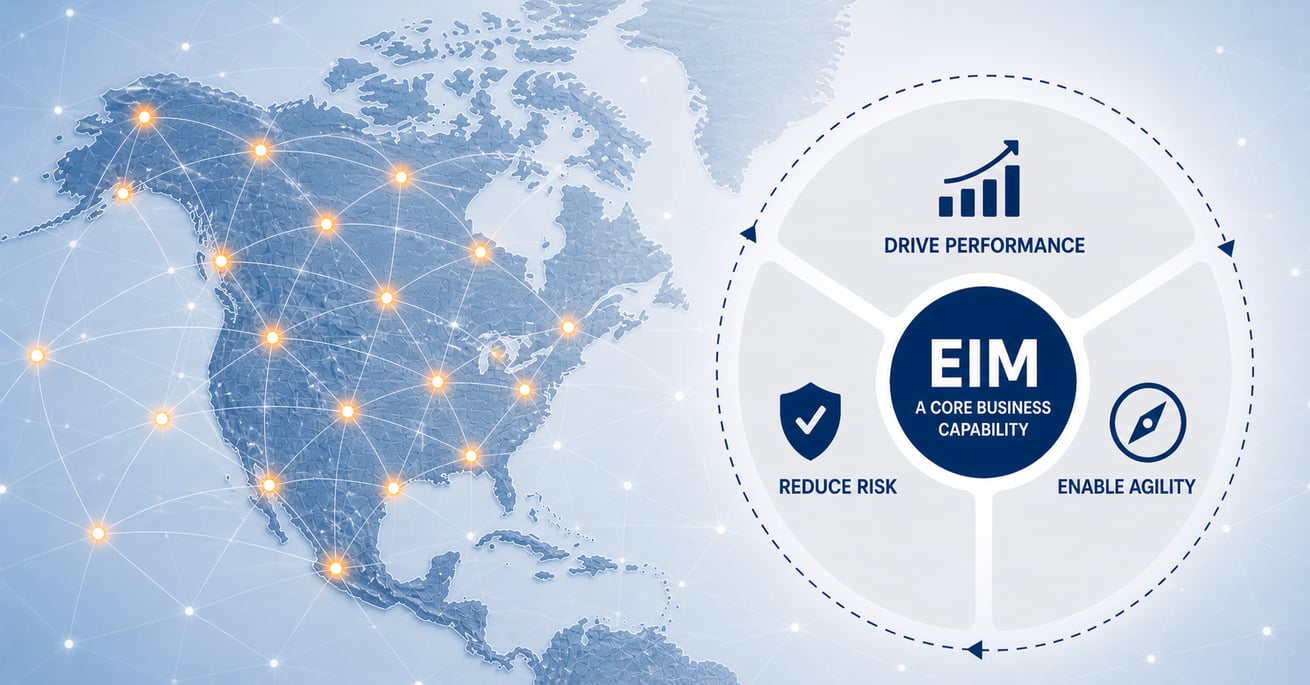
Enterprise Information Management (EIM) is no longer a back-office IT discipline. It is a core business capability that directly influences performance, risk, compliance, and long-term agility.
As organizations accelerate digital transformation, expand automation, and invest in artificial intelligence initiatives, the way they manage information often determines whether those efforts succeed or stall.
%20Matters%20Even%20More%20Now%20-%20visual%201.png?width=604&height=468&name=Why%20Enterprise%20Information%20Management%20(EIM)%20Matters%20Even%20More%20Now%20-%20visual%201.png)
Yet many enterprises still approach information management as a secondary technical concern. That mindset creates hidden risk. When information is fragmented, outdated, or difficult to trust, the impact reaches far beyond IT.
This article is part of Alitek’s Enterprise Information Management series:
▶ Part 1: Why Enterprise Information Management Matters More Than Ever
Part 2: The Business Value of Enterprise Information Management
Part 3: How to Define an Enterprise Information Management Strategy
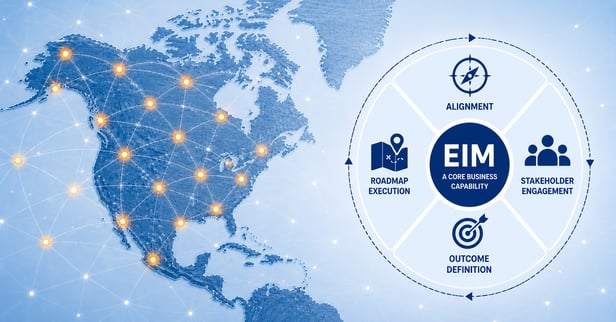
This article focuses on how successful organizations align stakeholders, establish governance, and create a practical roadmap for execution.
What Is Enterprise Information Management (EIM)?
Enterprise Information Management (EIM) is the coordinated discipline of managing information throughout its lifecycle—from creation and capture through use, governance, retention, and defensible disposition.
The purpose of EIM is to ensure information remains:
-
Accurate and trustworthy
-
Accessible when needed
-
Governed appropriately
-
Aligned with business processes
-
Available to support decision-making, automation, analytics, and AI
Organizations implement EIM to:
-
Reduce risk
-
Strengthen governance and compliance
-
Improve operational efficiency
-
Eliminate information silos
-
Enable digital transformation
-
Prepare for automation and AI
Without a defined EIM strategy, organizations often experience fragmented information, duplicate content, inconsistent reporting, and reduced confidence in business decisions.
Why Enterprise Information Management Matters
Every business process runs on information.
Documents, records, content, and data move through the processes that drive the organization. When information is incomplete, duplicated, inaccessible, or unreliable, business performance suffers.
Organizations often experience the symptoms as slow decisions, inconsistent reporting, compliance challenges, poor user adoption, or overly complex systems.
At their core, these are often information problems.
Enterprise Information Management provides the structure and discipline to address these challenges systematically rather than reactively.
What Problems Does Enterprise Information Management Solve?
Most organizations do not struggle because they lack information. They struggle because information is fragmented, duplicated, difficult to trust, or inaccessible when needed.
As information volumes grow and technology ecosystems become more complex, these challenges create operational inefficiencies, governance risks, and barriers to innovation.
Enterprise Information Management helps address several common business challenges.
Common Challenge
|
Business Impact
|
|
Information Silos
|
Departments maintain separate systems, repositories, and processes, limiting collaboration and creating inconsistent experiences across the enterprise.
|
|
Duplicate & Conflicting Information
|
Multiple versions of documents and reports reduce trust, slow decision-making, and force employees to spend time validating information.
|
|
Compliance & Governance Gaps
|
Retention requirements, privacy regulations, security controls, and audit readiness become increasingly difficult to manage without a structured approach.
|
|
Inefficient Business Processes
|
Disconnected systems and inconsistent information practices create delays, increase costs, and reduce organizational agility.
|
|
Limited Visibility for Leadership
|
Inconsistent reporting and fragmented information make it difficult for executives to gain a reliable view of performance, risk, and opportunity.
|
|
Challenges Supporting AI & Automation
|
Poor information quality limits the effectiveness of AI, analytics, and automation initiatives and reduces the value of technology investments.
|
As organizations increasingly invest in automation, analytics, and artificial intelligence, the quality, accessibility, and governance of information have become even more important. Information that cannot be trusted, located, or managed effectively creates barriers to innovation and limits the value of technology investments.
Why EIM Is the Foundation for AI Readiness
Artificial intelligence has elevated the strategic importance of Enterprise Information Management.
While many organizations view AI as a technology initiative, its success ultimately depends on the quality, governance, and accessibility of information. Without trusted information, even the most advanced AI solutions struggle to deliver reliable business value.
AI systems rely on information that is:
• Accurate
• Current
• Well-governed
• Properly classified
• Easily discoverable
• Consistently managed across systems
When enterprise information is fragmented, duplicated, outdated, or poorly governed, AI solutions often produce unreliable outcomes and increase business risk.
Enterprise Information Management provides the foundation for AI readiness by creating trusted information assets that support analytics, automation, knowledge management, and artificial intelligence initiatives.
Before organizations can trust AI, they must first trust their information.
Defining EIM Before Creating a Strategy
Before launching an initiative, leaders must align on what Enterprise Information Management actually means.
EIM is often misunderstood as:
In reality, EIM is an operating model. It is the coordinated discipline of managing information across its lifecycle, aligned to business processes, governance requirements, and enabling technologies.
It includes:
%20Matters%20Even%20More%20Now%20-%20visual%202.png?width=984&height=546&name=Why%20Enterprise%20Information%20Management%20(EIM)%20Matters%20Even%20More%20Now%20-%20visual%202.png)
When executed effectively, EIM simplifies the technology landscape, strengthens compliance posture, accelerates decision-making, reduces enterprise risk, and improves information quality.
Without a shared definition, strategy discussions often default to product selection. With clarity, the focus shifts to outcomes, accountability, and long-term value.
When an EIM Strategy Is Needed
Organizations rarely pursue EIM in isolation. Most act when business pressure exposes weaknesses in how information is managed.
Recognizing the right timing is critical.
Scenario
|
Common Drivers
|
|
Emergent Issues
|
Low user adoption, audit findings, compliance gaps, inconsistent reporting, and underperforming or fragmented content platforms.
|
|
Near-Term Planning
|
Cloud migration, platform modernization, content consolidation, system integration, and other transformation initiatives where existing information challenges risk being carried into new environments.
|
|
Strategic Planning
|
Mergers and acquisitions readiness, multi-region governance, analytics modernization, process automation, and artificial intelligence adoption.
|
EIM initiatives succeed when tied to clear business drivers such as risk reduction, operational efficiency, and strategic enablement.
When leaders connect information management to measurable outcomes, sponsorship strengthens and momentum builds.
Enterprise Information Management Delivers Business Value Across the Organization
Organizations that mature their EIM capabilities often experience:
✅ Faster decision-making
✅ Greater confidence in reporting and analytics
✅ Improved cross-functional collaboration
✅ Reduced audit and compliance burden
✅ Higher user adoption of enterprise platforms
✅ Better support for automation and AI initiatives
✅ Increased organizational agility during growth & change
The value of EIM is not simply better information management. It is the ability to operate more efficiently, govern more effectively, and make decisions with greater confidence.
Frequently Asked Questions About Enterprise Information Management
What is Enterprise Information Management?
Enterprise Information Management (EIM) is the discipline of managing information throughout its lifecycle to improve governance, compliance, efficiency, and business outcomes.
Why is Enterprise Information Management important?
EIM helps organizations reduce risk, improve decision-making, strengthen compliance, eliminate information silos, and support digital transformation initiatives.
How does EIM support AI initiatives?
Artificial intelligence depends on trusted, governed, and accessible information. EIM creates the information foundation required for successful AI, automation, analytics, and knowledge management programs.
What is the difference between EIM and ECM?
Enterprise Content Management (ECM) focuses primarily on managing documents and content. Enterprise Information Management is broader and includes governance, information lifecycle management, compliance, business processes, and organizational information strategy.
From Awareness to Action
Enterprise Information Management is not about organizing documents. It is about designing how information flows through the business, how it is governed, and how it supports decisions.
If information is the connective tissue of the enterprise, EIM is the discipline that keeps it healthy.
Organizations that define EIM clearly and act at the right time position themselves for resilience, compliance, operational efficiency, and long-term agility.
Every organization has an information management model, whether intentionally designed or not.
The question is not whether you have Enterprise Information Management. The question is whether it is enabling your business objectives—or standing in the way of them.
Continue the Journey
Understanding Enterprise Information Management is the first step. The next step is understanding the measurable business value it creates.
Read The Business Value of Enterprise Information Management to learn how organizations use EIM to reduce risk, improve operational performance, strengthen compliance, and prepare for AI-enabled growth.