How insurers can eliminate information silos, improve claims and underwriting performance, and accelerate Guidewire modernization
The hidden barrier to insurance modernization isn’t always the core system. It’s the content surrounding it. Industry research shows that 76% of insurance employees spend more than 30% of their day searching for information.[1] When claims files, policy documents, billing records, and customer correspondence are spread across multiple repositories, productivity suffers, service slows, and modernization initiatives become more difficult to execute.
For VPs of Claims and Underwriting, the challenge is not a lack of information. It is the inability to connect information to the decisions being made every day. Adjusters and underwriters cannot afford to spend valuable time searching across systems when customers expect faster service and regulatory requirements continue to increase.
- Disconnected content is a major barrier to insurance modernization.
- Information silos slow claims processing, underwriting decisions, and customer service.
- Modern document management improves access to customer information and business content.
- Connected content strategies strengthen governance, compliance, and audit readiness.
- Guidewire and OpenText help insurers connect content with core business processes.
This article is part of Alitek’s growing collection of industry-specific Enterprise Information Management resources.
Featured Industry Applications
Manufacturing: How Enterprise Information Management Reduces Cost of Quality
▶ Insurance: How Disconnected Content Slows Insurance Modernization
What Is Insurance Document Management?
Insurance document management is the practice of organizing, accessing, governing, and retaining policy, claims, billing, underwriting, and customer documents throughout the insurance lifecycle.
For insurers, effective document management is about more than storing content. It is about ensuring employees can quickly access the information they need to serve customers, make decisions, maintain compliance, and support modernization initiatives.
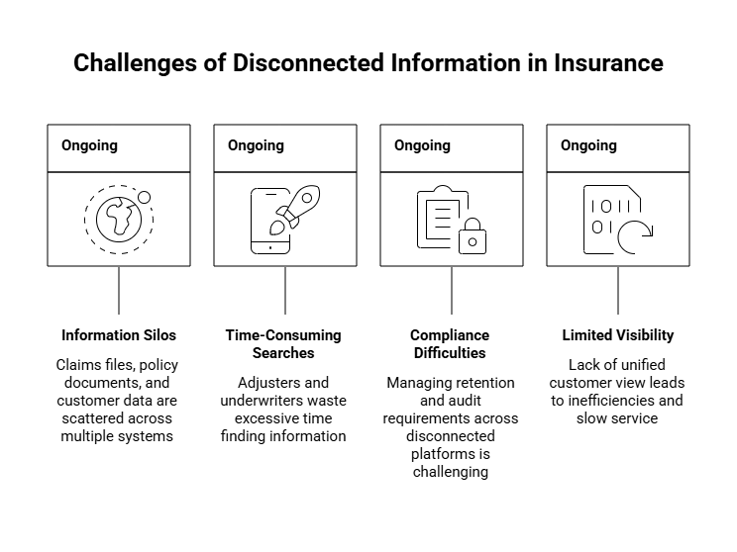
However, many insurers continue to manage documents across multiple repositories, legacy applications, and departmental systems. As a result, they face several common challenges:
-
Adjusters and underwriters spend excessive time searching for documents and customer information.
-
Compliance, retention, and audit requirements are difficult to manage across disconnected platforms.
-
Limited visibility into customer information creates inefficiencies and slows service delivery.
Why Is Document Management Important for Insurance Companies?
Document management directly impacts operational efficiency across claims, underwriting, billing, policy administration, pricing, and customer service.
When documents are stored across multiple systems, employees spend more time searching for information and less time serving customers. A connected document management strategy helps insurers:
Improve claims processing efficiency
-
Accelerate underwriting decisions
-
Simplify compliance and retention management
-
Reduce dependence on legacy systems
-
Support cloud modernization initiatives
-
Deliver a more complete customer view
The goal is not simply to move documents into another system. It is to make information easier to access within the processes where employees already work.
By connecting document management with core insurance operations, insurers can give claims professionals, underwriters, and service teams access to the information they need without switching between multiple systems. This helps improve productivity, speed decision-making, and support compliance.
Guidewire InsuranceSuite manages core insurance processes such as policy administration, underwriting, claims, and billing. OpenText Extended ECM manages the documents, correspondence, records, and customer content that support those processes. Together, they help insurers connect content with business transactions, giving employees access to the information they need without leaving their core workflows.
The Hidden Cost of Disconnected Content
Insurance organizations generate enormous volumes of information throughout the policy lifecycle, yet many still manage content across legacy repositories, departmental systems, file shares, and archived applications.
The impact is felt every day. Claims professionals and customer service representatives must navigate multiple systems to find the information they need, slowing decisions and increasing administrative effort.
The cumulative effect is significant: lower productivity, slower customer response times, higher operational costs, and limited visibility into the customer relationship.
Creating a Connected Information Ecosystem
Modern insurers need more than modern core systems. They need a connected information ecosystem that makes content accessible within the workflows where work occurs.
Instead of navigating multiple repositories, employees should be able to access claims, policy, billing, and customer information in context. The goal is not simply to centralize documents but to connect information to the business processes that depend on it.
When content is integrated into day-to-day workflows, employees spend less time searching and more time making decisions. This improves productivity, simplifies compliance, creates a more complete customer view, and helps deliver a more consistent customer experience.
Improving Claims Performance
Claims organizations face constant pressure to improve cycle times, reduce costs, and deliver exceptional customer experiences.
When adjusters spend time searching for documents, claim resolution slows and customer satisfaction can suffer.
A connected content strategy helps claims professionals access the information they need within the flow of work. Photos, estimates, correspondence, reports, and historical records become easier to locate and use, helping teams make faster and more informed decisions.
The result is improved productivity, reduced administrative effort, and faster claim resolution.
Accelerating Underwriting Decisions
Underwriters rely on complete and accurate information to evaluate risk effectively.
When supporting documentation is fragmented across multiple systems, underwriting becomes slower and more labor-intensive.
By making applications, inspections, correspondence, policy history, and supporting records readily available, insurers can create a more efficient underwriting process while providing underwriters with a more complete picture of the risk.
This enables faster decision-making, improved responsiveness, and more efficient underwriting operations.
Strengthening Information Governance
Insurance organizations face significant regulatory and retention obligations.
Managing compliance across multiple content repositories increases complexity and risk. Inconsistent retention policies, fragmented audit trails, and varying access controls can create governance challenges that consume valuable business and IT resources.
A connected information management strategy helps insurers apply governance policies consistently across the document lifecycle, improving compliance, reducing risk, and strengthening audit readiness through automated retention schedules, audit capabilities, and centralized controls.
Insurance Document Management FAQs
What are information silos in insurance?
Information silos occur when policy, claims, billing, underwriting, and customer documents are stored in separate systems that do not share information efficiently. These silos make it difficult for employees to access complete customer information and can slow operational processes.
How do information silos impact claims operations?
Information silos force adjusters to search across multiple systems for supporting documents and customer information. This can increase claim cycle times, reduce productivity, and negatively impact customer experience.
Why is document management important for Guidewire modernization?
Many insurers maintain large volumes of historical content in legacy repositories. A document management strategy helps organizations connect active content to Guidewire workflows while preserving historical records needed for compliance, audits, and customer service.
How does document management improve underwriting?
Document management gives underwriters faster access to applications, correspondence, inspections, policy history, and supporting documents. This reduces administrative effort and helps accelerate underwriting decisions.
What role does OpenText Extended ECM play in insurance?
OpenText Extended ECM helps insurers connect content and business processes, making documents available within operational workflows while supporting governance, compliance, and modernization initiatives.
What if my current document management platform is not performing well?
Many insurers have legacy document management platforms connected to Guidewire that no longer provide the performance, usability, or business value needed in today’s insurance market.
Rather than investing in a costly platform redesign, insurers often choose to modernize with a best-in-class enterprise content management platform such as OpenText Extended ECM. Its integration with Guidewire helps improve information access, governance, and operational efficiency.
Better Information Drives Better Outcomes
For VPs of Claims and VPs of Underwriting, the business case is straightforward. When critical information is difficult to access, productivity declines, decisions take longer, and customer service suffers.
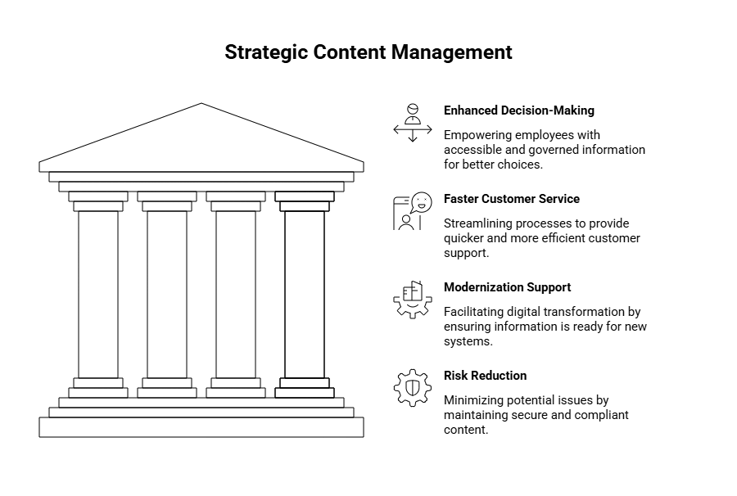
Insurers that connect content to business processes can reduce information silos, improve operational efficiency, strengthen governance, and accelerate modernization initiatives. More importantly, they enable claims professionals and underwriters to focus on what they do best: serving customers, managing risk, and making informed decisions.
In an industry where every policy, claim, and customer interaction depends on information, connected content is more than an operational advantage. It is a foundation for business performance.
Sources
[1] Liferay, Insurance Knowledge Management (referencing insurance industry research indicating that 76% of insurance employees spend more than 30% of their day searching for information).