
Measurement
Manual invoice touches
Current State
Multiple people review routine invoices
Target State
People focus primarily on exceptions


 SAP ECC & S/4HANA (private cloud editions)
The Problem

Too many people manually touch every invoice.

Invoices take too long to reach SAP, payments run late, and early-payment discounts are missed

AP teams revert to email, spreadsheets, and SharePoint after go-live

VIM features were never configured or adopted, or the implementation has not been upgraded in years

Approval workflows do not reflect how the company operates because business rules were assumed instead of documented

Weak archiving, document security, or OpenText ecosystem integration

Limited visibility into invoice status and payment obligations

Merged or acquired companies run conflicting VIM environments

An AI or OCR capture tool was added, but invoices still are not processed correctly

Projects stall because requirements were captured only at a high level, or the team never spoke with the people doing the work

High invoice-processing labor costs keep finance viewed as an expensive cost center
How Alitek Solves It

Configure business rules so routine invoices that meet established criteria move through the system automatically, reducing manual touches up to 50% and leaving people to review only genuine exceptions.

Reduce the delays between receipt, validation, approval, and posting, shortening payment cycles and increased early pay discounts up to 80%.

Map the actual AP workflow with the people who do the work, configure the organization-specific rules that generic setups skip, and support your team until VIM is the standard way of working.

A VIM Health Check identifies unused functionality, configuration gaps, and version issues, and Alitek then delivers the appropriate upgrade or optimization.

Document rules, thresholds, exceptions, and responsibilities directly with AP users and process owners, then configure approvals around what is actually true.

Design archiving, retention, document security, and residency requirements into the VIM solution rather than treating them as an afterthought.

Give finance a system-generated record of capture, approvals, exceptions, and payment commitments they can act on and produce in an audit.

Consolidate versions, configurations, processes, and user roles into a single aligned environment.

Capture tools extract information from invoices, but they do not understand your business processes, SAP relationships, exception types, approvals, archiving, and controls required to process invoices correctly. Alitek configures VIM to carry the process the rest of the way.

Begin every engagement with structured requirements gathering and direct access to AP users, which is the specific gap our current-state evaluation exists to close.

Reduce the manual entry, routing, and review work that drives headcount and contract labor, reducing the cost per invoice by 75% so people can be redirected toward higher-value work.

AP processes tend to be roughly 90% similar from one organization to another. The remaining 10% includes the specific rules, exceptions, responsibilities, and business requirements that determine whether VIM actually works. A "fast track" implementation may configure the common 90%, but it is that final 10% that decides whether users stay in the system or abandon it and return to manual work.
A properly configured VIM environment will reduce manual invoice touches, speed up payments, improve capture accuracy, take advantage of more vendor discounts, and strengthen vendor relationships. Every organization processes invoices differently, so Alitek documents your rules with the people who actually do the work, then configures VIM to enforce them automatically:

Purchase order rules
Exception categories
Goods receipt processes
Payment commitments
Approval thresholds
Document policies
Vendor requirements
Audit requirements

Invoices move automatically when they meet your business rules, so employees focus on exceptions instead of reviewing every transaction.

Delays between invoice receipt, validation, approval, posting, and payment are cut so invoices move on time.

Qualifying invoices are processed quickly enough to take advantage of available early-payment discounts.

Finance teams get a clearer view of invoice status, exceptions, payment commitments, and cash requirements.
SAP Vendor Invoice Management is the process of capturing, validating, routing, approving, posting, archiving, and tracking supplier invoices within an SAP environment. Alitek commonly performs this work using OpenText Vendor Invoice Management integrated with SAP and configured around the organization's accounts payable rules.
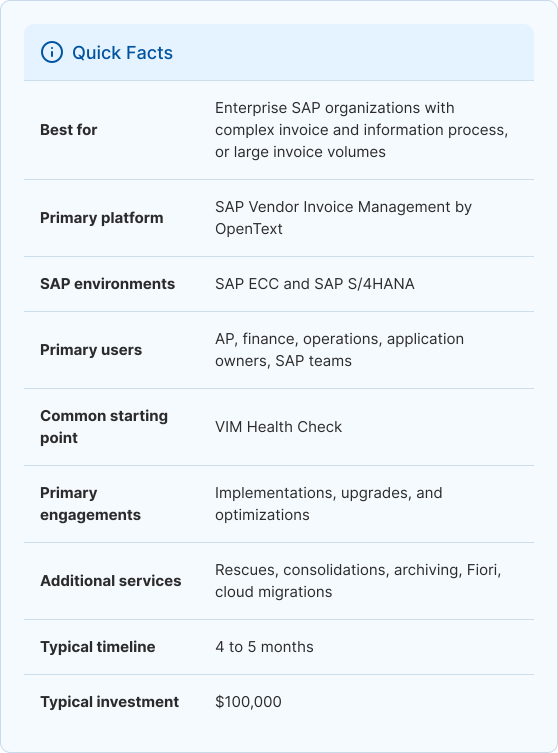
Rather than automating every existing step, the work begins by determining which activities are required, which can be automated, which should be redesigned, and which should be removed.
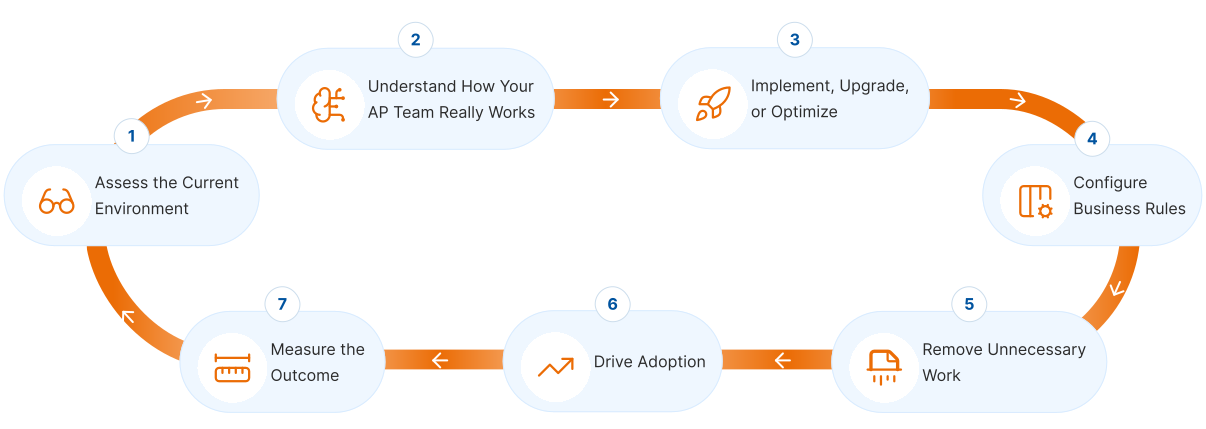
Stage 1

Health Check

Determine whether the current VIM environment, business process, and SAP ecosystem are aligned, typically completed in 1 to 3 weeks.
Stage 2
AP Workflow Mapping
Meet with the people who perform and manage accounts payable work. Document invoice paths, approval paths, governing rules, workarounds, and dependencies.
Stage 3
Process Rationalization
Identify what should be automated, simplified, reconfigured, retained, or removed.
Stage 4
VIM Configuration
Configure the solution to reflect the company's actual processes instead of a generic quick-start model.
Stage 5
Implementation or Optimization
Deliver the agreed VIM implementation, upgrade, rescue, consolidation, or optimization.
Stage 6
Adoption and Stabilization
Support the AP team, finance leadership, and system owners as the new process becomes the standard way of working.
Stage 7
Continuous Improvement
Review performance: exception reduction, additional automation, Fiori adoption, archiving, cloud and S/4HANA readiness, and a continuous clean core alignment.

"Rather than assuming a standard configuration will be sufficient, we begin with the people, processes, rules, and reasons that determine how invoice management must work inside your business."

Alitek supports organizations that continue to operate SAP ECC and need to implement, upgrade, or improve VIM before or during broader SAP modernization. With mainstream ECC support scheduled to end in 2027, we help AP teams plan VIM upgrade paths that protect their investment through the transition to S/4HANA.

Alitek supports VIM work connected to SAP S/4HANA initiatives, including preparation for broader modernization and clean core requirements. This covers both brownfield conversions and greenfield implementations, across on-premise and private cloud editions.

Alitek supports organizations that continue to operate SAP ECC and need to implement, upgrade, or improve VIM before or during broader SAP modernization. With mainstream ECC support scheduled to end in 2027, we help AP teams plan VIM upgrade paths that protect their investment through the transition to S/4HANA.
Alitek knows OpenText's cloud-based intelligent capture service. It uses AI and OCR to automatically capture, validate, and process documents like vendor invoices, then routes them straight into SAP workflows.

VIM Health Check
For organizations that want to know whether their VIM environment, business process, and SAP ecosystem are aligned.
Performance and configuration review
Manual workaround identification
Exception handling and adoption assessment
Optimization priorities

New VIM Implementation
For SAP organizations that need to implement VIM configured around their actual AP processes.
Requirements discovery and AP workflow mapping
VIM configuration
SAP and OpenText integration
Testing and deployment support

VIM Upgrade
For organizations that implemented VIM several years ago and are not using newer functionality or supported configurations.
Current-version assessment
Upgrade planning and feature-gap analysis
Post-upgrade optimization
VIM Optimization
For functioning VIM environments that still include excessive manual work, exceptions, slow approvals, or missed discounts.
Current-version assessment
Upgrade planning and feature-gap analysis
Post-upgrade optimization

Implementation Stabilization
For companies that started a VIM install but never achieved the expected business results.
Diagnose why the implementation underperformed
Correct configuration problems
Move users away from manual workarounds

M&A Consolidation
For organizations combining different SAP or VIM versions after acquiring or merging with another business.
Version alignment
Process harmonization
Configuration consolidation
User and role alignment

SAP S/4HANA Preparation
For organizations assessing how their VIM environment must change as part of an S/4HANA or clean core initiative.
Assess VIM against S/4HANA requirements
Plan changes before or during the move

Archiving & Document Management
For organizations that need to improve how invoice documents are stored, secured, retained, and accessed.
OpenText archiving integration
Retention and document security
Geographic document requirements

Fiori Expansion
For organizations that want to extend invoice-management workflows through SAP Fiori.
Extend VIM functionality through SAP Fiori

Cloud Migration
For companies moving VIM, OCR, archiving, SAP, or related document services into a cloud environment.
VIM and OCR migration planning
SAP and OpenText cloud considerations
Document-residency planning
Security and archive planning

Oil & Gas

Liquefied Natural Gas

Pipelines

Refineries

Utilities and Power

Nuclear

Manufacturing

Food, Beverage & Liquor Distribution

Retail
Current-State Evaluation
Stakeholder and AP-user interviews
Current-process review
VIM configuration review
SAP environment review
OpenText ecosystem review
Version and upgrade review
Exception and manual-workaround analysis
Findings and recommendations

Process and Solution Design
AP workflow mapping
Business-rule documentation
Exception categorization
Approval logic
Automation and process-removal opportunities
SAP integration requirements
Archiving, security, and residency requirements

Configuration and Implementation
VIM configuration
SAP integration
Capture configuration and validation rules
Approval workflows and exception routing
Archiving integration and security configuration
Fiori and cloud configuration, when included

Testing and Launch
Configuration and integration testing
User acceptance testing
Exception testing
Deployment planning
Go-live and stabilization support

Adoption and Optimization
AP-user and process-owner training
Updated process documentation
Exception-management guidance
Post-launch review
Optimization recommendations
Current-state review
AP process interviews
VIM review
SAP and OpenText review
Findings
Prioritized recommendations
Typical investment: $150,000 to $500,000
Typical duration: 4 to 6 months
Typical investment: $75,000 to $200,000
Typical duration: 3 to 8 months
Typical investment: $50,000 to $150,000
Typical duration: 2 to 6 months

WHAT WE’LL NEED FROM YOU:

Acknowledged business problem
Executive sponsorship
Access to AP users
Clear process ownership
Time for requirements gathering
SAP and OpenText technical participation
Willingness to change processes
Commitment to user adoption
Before implementation begins, Alitek documents what will be delivered, what it will cost, how long it is expected to take, and what the customer must provide for the project to succeed.
A short evaluation can determine why invoices still require hands-on effort, whether the setup reflects the business, which features are not being used, and whether the solution should be optimized, upgraded, rescued, consolidated, or replaced.
 Experienced VIM specialists
 Business process review alongside the software
 Prioritized recommendations
 No generic fast-track configuration