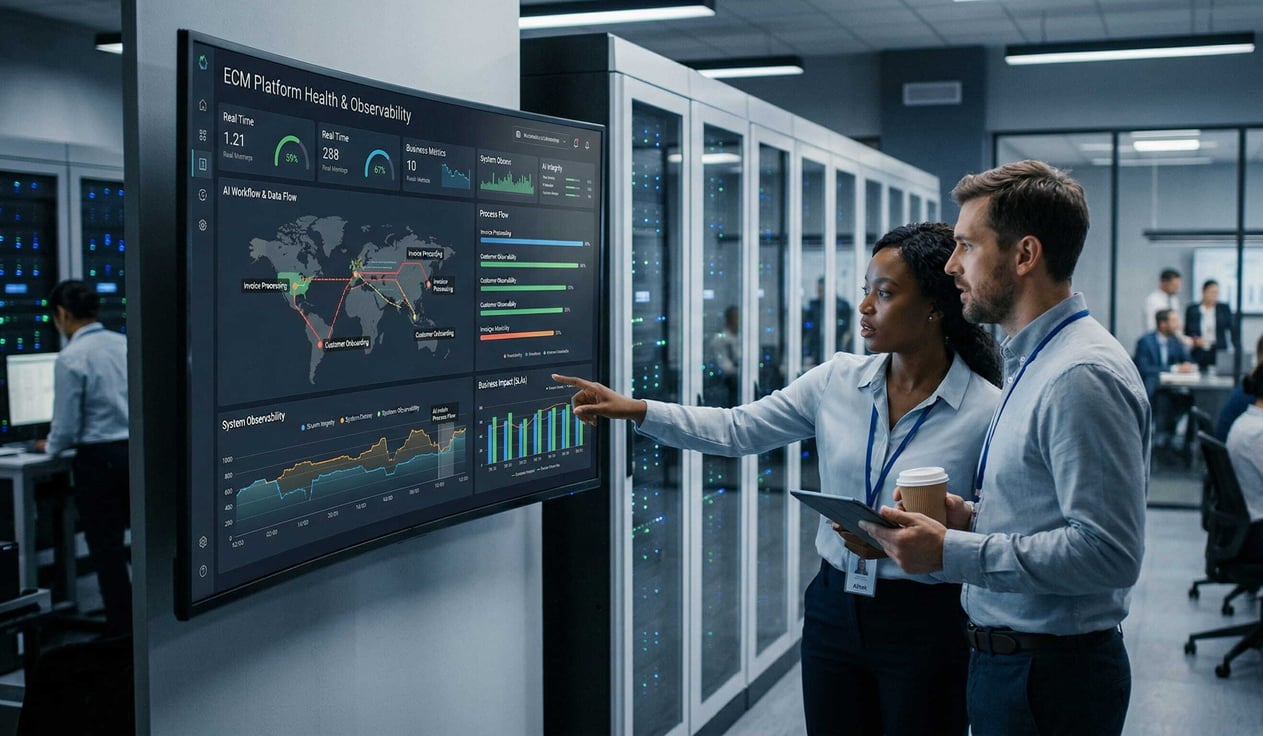
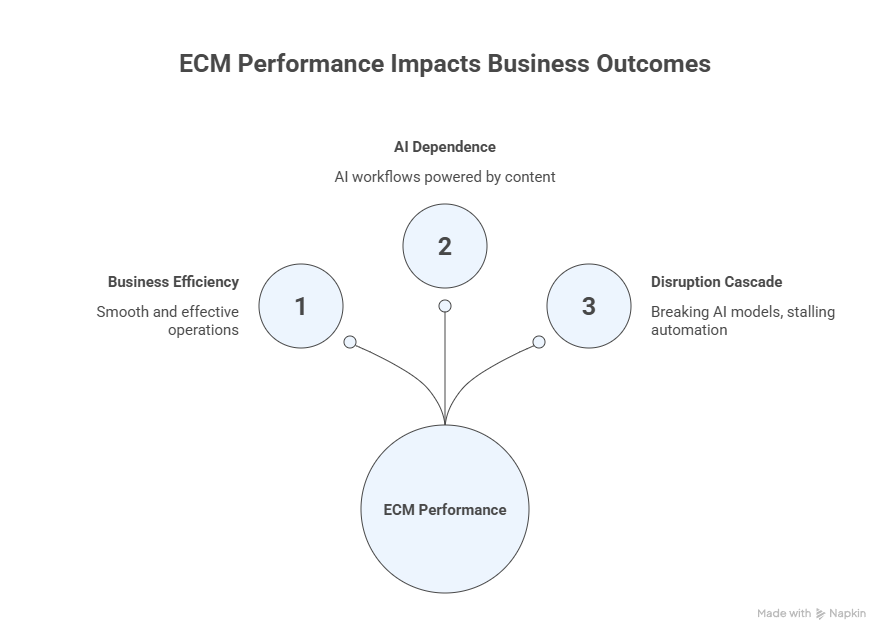
Enterprise Content Management (ECM) platforms are no longer back office utilities. They are the digital backbone of modern organizations, supporting document intensive, business critical processes such as invoice processing, customer onboarding, claims management, contract lifecycle management, and regulatory compliance. When these systems perform well, the business moves efficiently. When they do not, the impact is immediate and far reaching.
This importance has only intensified with the rapid adoption of artificial intelligence. Modern AI initiatives, from intelligent document processing and generative AI to search augmentation and decision automation, depend heavily on unstructured information stored within ECM platforms. While AI workflows may appear separate
from the ECM system, they are fundamentally powered by the content, metadata, and processes managed there.
Any disruption, degradation, or data quality issue within the ECM environment can cascade downstream, breaking AI models, stalling automation, and undermining confidence in AI driven outcomes across the business.
Despite this reality, many enterprises still rely on limited infrastructure monitoring or reactive troubleshooting to manage their ECM environments. That approach is no longer sufficient. Today's ECM platforms are complex, interconnected ecosystems that require a more advanced strategy: robust monitoring paired with true observability.
The Evolving Role of ECM in the Enterprise
ECM systems such as OpenText Content Server, Documentum, SharePoint, and OpenText Capture platforms have evolved far beyond simple document storage. They now underpin end to end business workflows and integrate tightly with line of business applications, like ERPs and CRMs, and analytics systems.
This evolution introduces new risks:
- A slowdown in one component can cascade across downstream processes
- Failures are not always visible at the infrastructure level
- Users often discover issues only after productivity has been impacted
Because ECM platforms sit at the intersection of people, processes, and data, even minor disruptions can escalate into missed SLAs, compliance issues, or lost revenue.
Monitoring Is Necessary but Not Sufficient
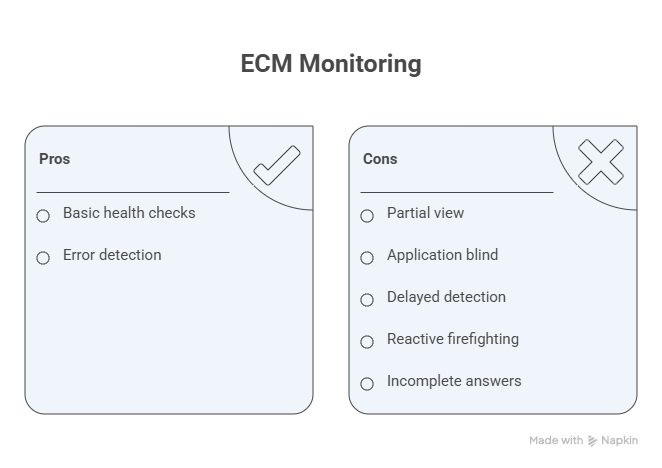
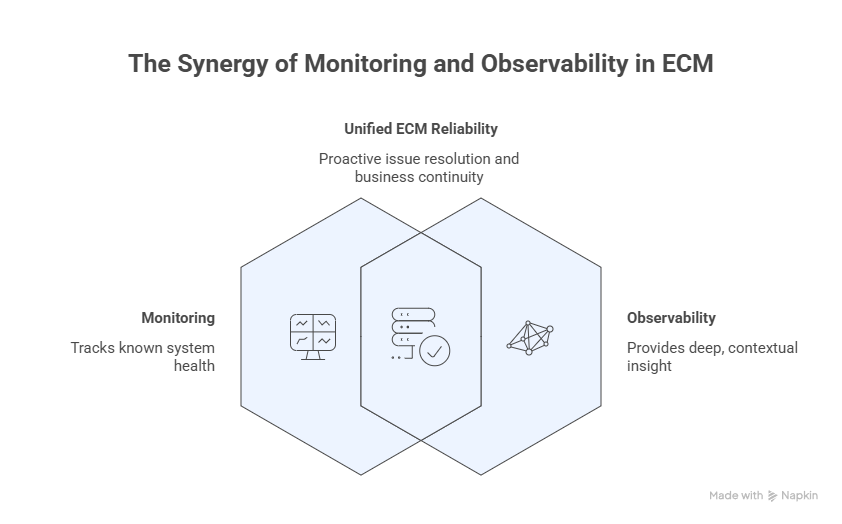
Traditional monitoring focuses on predefined metrics and thresholds such as CPU utilization, disk space, memory consumption, service availability, and basic error conditions. These signals matter, but they provide only a partial picture of system health.
Infrastructure level monitoring might tell you that servers are running, databases are online, and network connections are healthy.
Yet users may still be unable to log in, workflows may be stalled, indexing may be failing, or capture jobs may be backing up. Many ECM failures occur at the application and workflow layers, well beyond the visibility of infrastructure tools.
This often leads to delayed issue detection, long troubleshooting cycles, and reactive firefighting driven by user complaints.
Monitoring answers the question "Is something broken?" but not "Why is it happening, where did it start, and what should we do next?"
This gap is one of the most common reasons organizations turn to application level monitoring and managed services for ECM platforms, where system health is measured by real user and process performance, not just server uptime.
Observability Provides the Full Picture
Observability builds on monitoring by delivering deep, contextual insight into how systems behave internally. Instead of focusing only on known failure conditions, observability helps teams understand complex systems even when issues were not anticipated.
In ECM environments, observability combines multiple signals, including application level metrics such as logins, searches, uploads, and workflows, logs and error messages, performance trends over time, and dependencies between ECM components and integrated systems.
The DevOps Research and Assessment (DORA) team has found that high performing organizations use observability to reduce Mean Time to Detect and Mean Time to Restore service, directly improving reliability and business performance. (DORA, Monitoring and Observability Capabilities)
By correlating these signals, observability answers critical questions: which component triggered the issue, how long the problem has been developing, which business processes are affected, and what action resolves the root cause rather than just the symptom.
This is why many enterprises pair observability with dedicated ECM monitoring platforms like AlitekWatch, which are designed specifically to understand how OpenText and other ECM systems behave in real enterprise environments.
Why Observability Is Critical for ECM Platforms
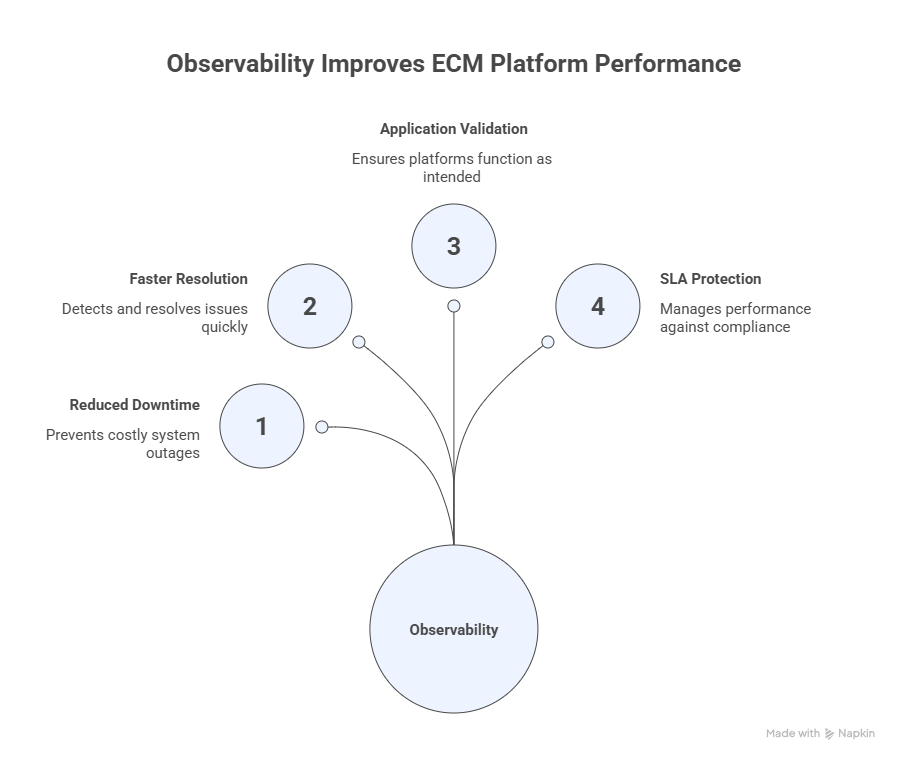
Preventing Costly Downtime
Unplanned downtime is one of the most expensive risks in ECM environments. When content systems are unavailable, employees cannot complete work, critical documents are inaccessible, and customer facing operations slow or stop.
NIST highlights continuous monitoring as a foundational practice for reducing operational risk in complex systems. (NIST SP 800-137, Information Security Continuous Monitoring)
Observability enables proactive detection of issues before users are impacted by identifying early warning signals such as rising response times, failing background jobs, or resource contention.
Reducing Mean Time to Detect and Resolve Issues
Without observability, issue detection often depends on user reports. By the time a ticket is logged, business impact has already occurred.
DORA research shows that organizations with strong observability practices detect issues faster and restore service more quickly than those relying on reactive approaches.
Moving Beyond Infrastructure Only Monitoring
Infrastructure health does not reflect application behavior or user experience.
Application level observability validates that ECM platforms are functioning as intended, not simply powered on.
Protecting SLAs and Compliance
ECM platforms often support regulated processes where availability, accuracy, and timeliness are mandatory. Observability provides the visibility needed to manage performance against SLAs and intervene before compliance thresholds are breached.
From Reactive Support to Proactive Operations
Observability enables a shift from reactive support to proactive operations.
With observability in place, teams can detect issues before users are impacted, trigger corrective actions for known failure patterns, eliminate recurring problems by addressing root causes, and spend more time optimizing systems.
In mature environments, this approach is often delivered through ongoing managed services for OpenText and ECM platforms, where monitoring insights directly inform continuous improvement.
Observability Is No Longer Optional
Enterprise Content Management platforms sit at the center of digital operations. As these systems grow more complex, traditional monitoring alone is no longer enough.
Monitoring tells you when something is wrong. Observability tells you why and what to do next.
By investing in application level monitoring and true observability, organizations can reduce downtime, improve performance, protect SLAs, and ensure ECM platforms deliver value instead of risk.